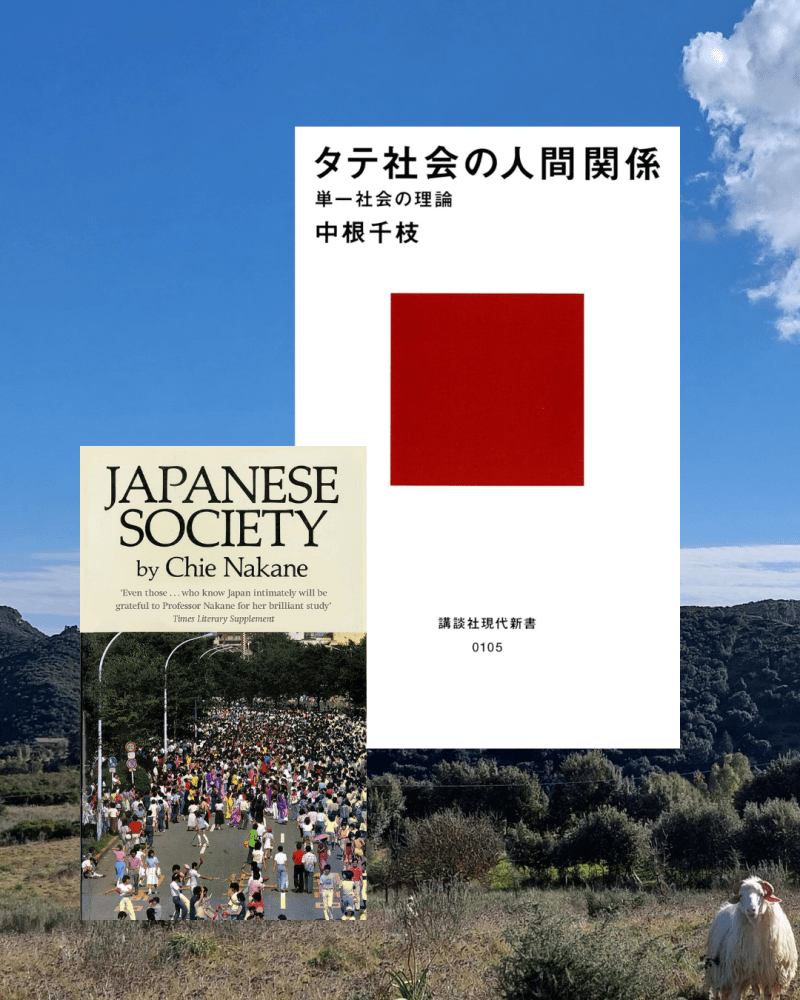
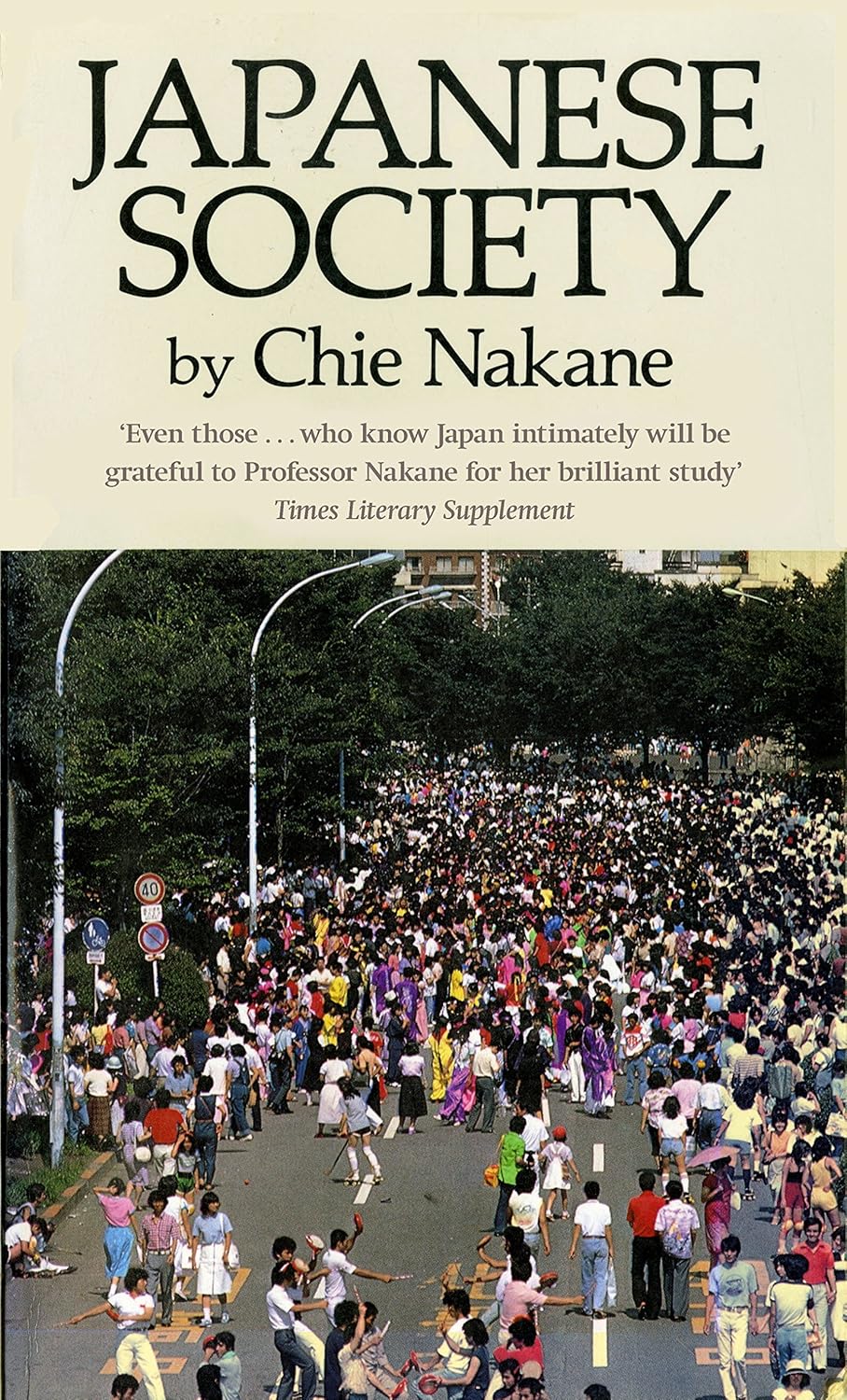
Japanese Society
Chie Nakane, 1967
タテ社会の人間関係
単一社会の理論
中根千枝
172 pages
Read in 2010
Check the synopsis and details on amazon.com
🔽 Summary and quick note 🔽
✔ A classic study of Japanese society as a "vertical society"
✔ Logical explanations of how and why Japanese have behaved historically and today
✔ Originally written in 1967 but still relevant to understand Japan and its people

★★★★★ It's not about dissing Japan or how to survive living in Japan, it explains how the "vertical society" in Japan operates, in a concise and logical way. In the last 60 years, Japanese society has not changed much, rather unsurprisingly. Still relevant and helps anyone to understand Japan.
🔽 Book review 🔽

It's a pity that they have decided to omit the word "vertical" from the English title, because that is the keyword throughout the book, and indeed throughout history of Japan that it's a vertical society.

The book is not a critique of Japanese society, or self help of how to survive in Japan, it's about the structure of Japanese society and unsurprisingly, rather than surprisingly, it has not changed much for the last 60 years or so, since 1967 when it was originally published.

It talks about the structure of Japanese society as a whole, then about internal groups within the society, about the relationship between leaders and the groups, then about human relationship.

I read it in Japanese so some of the terms might be translated differently in English.
There are concepts of "uchi" (inside, us, home) and "soto" (outside, them, foreign) that anyone in the world would be familiar with, but in Japan it is very strict.
For example, when you ask an employee what their job is, they'd say "I work for this company" rather than "I am an engineer", this actually prohibits creating a community of engineers in wider community, because they'd feel that an engineer of another company is a competitor.
This sense of "uchi" has created a structure in workplace where you are only rewarded if you work long period (which you would in Japan because it's rare to change jobs even today) that is, your salary will always be lower than the old man sitting in a corner because he's been sitting there decades longer than you.
It's not something unique in Japan, it definitely happens in other countries too, but the problem is that it's been the default in Japan.
It's fed to Japanese people from young age, and creates the sense of forced equality; you are expected to work hard to be average in everything, being good at one thing or work hard on one thing is not good enough.

Another interesting idea for me was the emphasis on emotions rather than contract at workplace.
Neither party dares to think that if the employee is working more than what's on contract then they should be compensated.
And because emotions come first, they hate to give objective opinions especially to their leaders, however, if they fully respect a leader, they'd go beyond their obligations happily.

To be clear, the book is not about how "bad" Japan is to have this kind of structure.
If your employer takes care of you for the rest of your life, and by extension your family, it's not necessarily a bad thing, and if you can stick to one employer and manage to stay/tolerate, you are guaranteed to get higher salary regularly - well that's not bad either if you are planning to buy a house with a mortgage.
But, I think the problem is lie on the fact, the reality, that a lot of it was based on a fantasy, a fantasy that "we all  think the same"
Unspoken rules, everyone-says-so, a common sense, us vs them - they don't actually exist.
It looks like they do because the people who have suffered from this have stayed quiet, because Japanese society has ignored their existence, and it pretended that people would simply obey.
Today employers do not guarantee your position in the company for 40 years, instead, workers change jobs, many more prefer freelancing, there are many super talented young people who earn a lot more than their fathers, there are women working against the patriarchy, there are foreigners with their traditions and cultures - surprise, there are "threats".

Sure the book was published nearly 60 years ago so Japan has changed, finally changing, a bit.
But it takes time to change a society, especially Japan who has enjoyed its very unique geopolitical position.
The book is still very relevant today, for anyone who want to understand Japanese society, and even for Japanese people who don't feel comfortable in their own country; metacognition will keep us sane.
🔽 Related pages 🔽
🔽 Where to buy / Summary and more info 🔽

●●● Amazon.com (US) ●●●

Japanese Society



 赤パンの本棚 akapan's bookshelf